
INDUSTRIAL HERITAGE · GERMANY
Carl Zeiss Jena
Precision optics from Jena — and the machine that put the stars under a dome
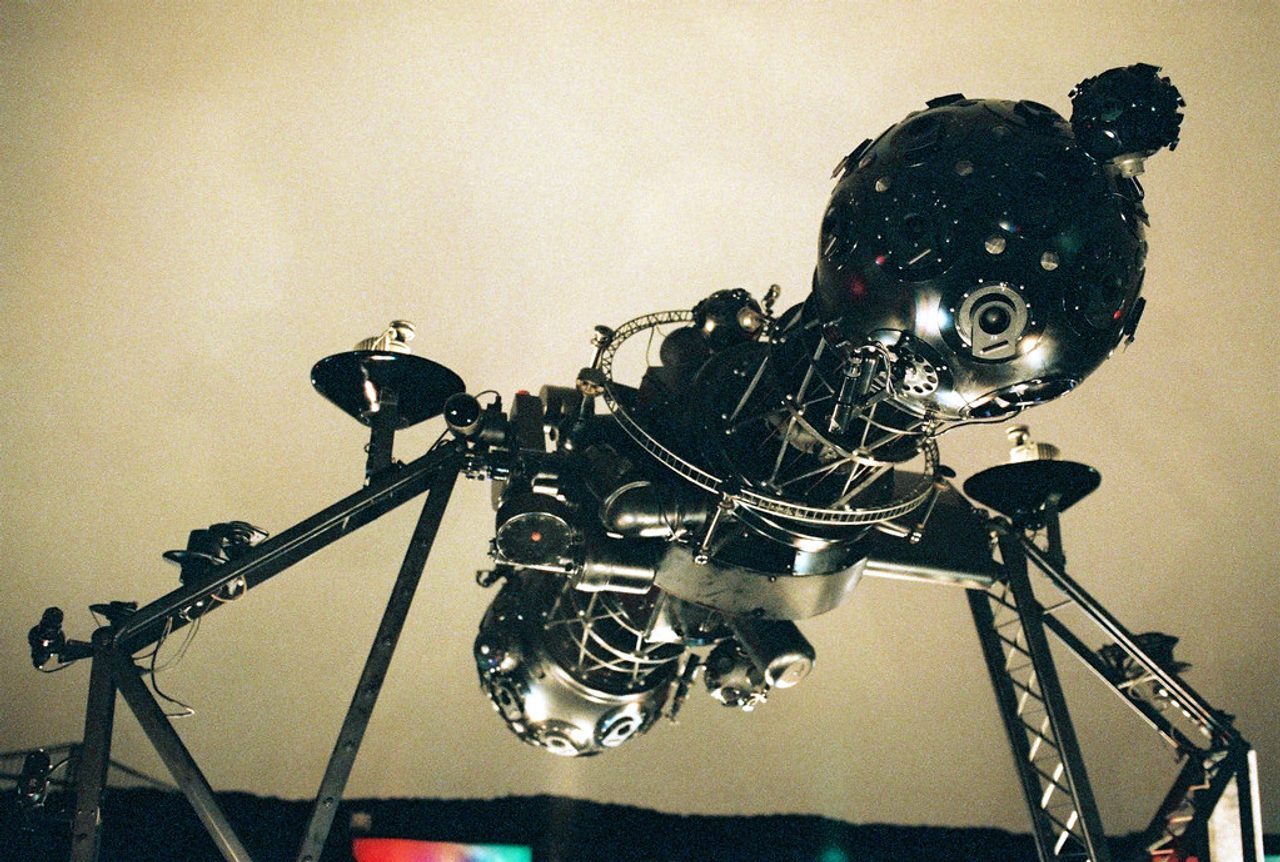
Photograph · A Zeiss star projector in Jena — “Jena (1)” by halfrain — CC BY-SA 2.0 · Credits
01 In brief
In 1846, precision mechanic Carl Zeiss opened a microscope workshop in the university town of Jena, in Thuringia. The firm that grew from that workshop — first through the optics mathematics of Ernst Abbe, who joined in 1866, then through the specialty glasses of Otto Schott — became one of the founding legends of modern precision engineering, and its instruments still set standards in microscopy.
This profile reaches beyond the Alpine arc for a story that belongs to it. In 1923, Zeiss engineer Walther Bauersfeld invented the projection planetarium, first demonstrated publicly at the Deutsches Museum in Munich — an institution this atlas already documents. The purpose-built Zeiss-Planetarium in Jena, opened on 18 July 1926, has been running ever since: the oldest continuously operating planetarium in the world.
02 Why it's interesting
- 01 Abbe turned lens-making from craft into science: his mathematical theory of image formation made it possible to design objectives rather than grind and hope — the foundation of modern optical engineering.
- 02 The Zeiss–Schott partnership created the optical-glass industry in Jena: the material basis for microscopes, camera lenses and planetarium projection alike.
- 03 Bauersfeld's projection planetarium put the entire sky under a dome — and the test shell built for it on the factory roof was an early geodesic dome, decades before that idea found a famous name.
- 04 The Jena planetarium has now operated for a full century, through monarchy, dictatorship, division and reunion — a hundred years of public science under one dome.
03 How it works
A projection planetarium replaces the sky with a machine: thousands of tiny lenses and pinholes, mounted on moving cages at the ends of driven arms, reproduce the stars and planets as seen from any point on Earth at any time in history.
Bauersfeld's insight was that the sky is a sphere — so the projector became one too: a dumbbell of spherical cages, each carrying plates of punched star images, geared to reproduce the ratios of astronomical time. Under a hemispherical dome the effect is the night sky rendered with an accuracy no painted ceiling could match.
The 1923 Munich demonstration and the 1926 Jena dome established the format every planetarium since has followed. Today's hybrid systems combine mechanical star projectors — modern descendants of the Jena machines — with fulldome video, and Zeiss projectors still serve planetariums worldwide.
| Workshop founded | 1846, Jena (Thuringia) |
|---|---|
| Ernst Abbe | Joined 1866 · partner from 1875 |
| Otto Schott's glassworks | Jena, 1884 |
| First projection planetarium | Deutsches Museum, Munich, 21 October 1923 |
| Zeiss-Planetarium Jena | Opened 18 July 1926 |
| Jena dome today | Oldest continuously operating planetarium |
Dates per ZEISS corporate history and the Zeiss-Planetarium Jena's published history.
04 The organisation behind it
The Carl Zeiss works grew into a foundation-owned enterprise — the Carl-Zeiss-Stiftung established by Abbe in 1889 — whose statutes pioneered worker rights and independence from heirs' whims alike. The twentieth century divided the firm between Jena and Oberkochen; after German reunification, Jena again hosts major Zeiss operations, including microscopy, and the planetarium carries the founding name into its second century.
05 In the real world
Optics from Jena framed both the invisible and the far away: microscopes that opened cell biology, and planetarium projectors that taught generations of schoolchildren the sky. The dome-plus-projector format invented in 1923 now operates in thousands of planetariums worldwide, and the star-projector's dumbbell silhouette remains the universal symbol of the institution.
06 Can you visit?
The Zeiss-Planetarium Jena presents public shows — check the current programme on its official website before visiting. The building, a Zeiss factory dome turned temple of the sky, is itself worth the trip.
Jena lies in Thuringia, north of the atlas's mapped Alpine frame; Munich's Deutsches Museum — where the first projector premiered — is the Alpine-region companion to this story.