
INDUSTRIAL HERITAGE · AUSTRIA
Semmering Railway
The 1850s mountain railway so beautiful it became a World Heritage landscape
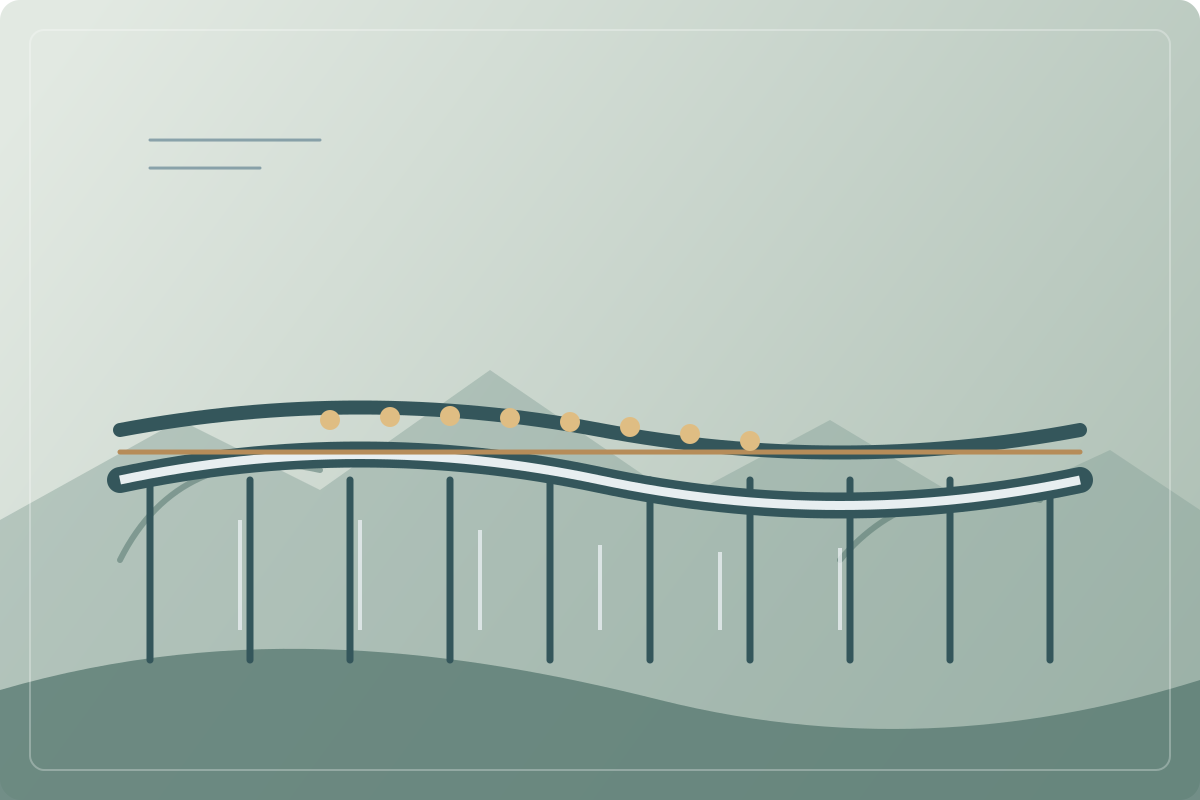
Original schematic illustration · created for the Atlas — stylised technical drawing, not a photograph.
01 In brief
Between 1848 and 1854, under chief engineer Carl von Ghega, the Semmering Railway was built over 41 kilometres of high mountains between Gloggnitz and Mürzzuschlag — climbing from 436 m to a summit of 895 m before descending to 677 m. Its designers answered the challenge with a landscape of engineering: fourteen tunnels and sixteen major viaducts, curving viaduct after viaduct across steep valleys, on gradients and curve radii that pushed 1840s railway technology to its limits.
The line, inscribed by UNESCO as a World Heritage site in 1998, is regarded as one of the pioneering masterpieces of mountain railways — and it remains in daily service, carrying regional trains between Vienna's basin and Styria. The mountain it crosses is now also being pierced a second time: beneath the historic route, the twin-tube Semmering Base Tunnel (27.3 km per tube) was broken through at the end of 2024 and is planned to open around 2030.
02 Why it's interesting
- 01 It is civil engineering elevated to landscape art: the viaducts were built of stone in deliberate harmony with the mountain scenery — an aesthetic choice that helped earn World Heritage status for a working railway.
- 02 It proved that standard-gauge railways could cross real mountains, unlocking the Alpine rail age that followed — including the great base-tunnel era the new Semmering tunnel continues today.
- 03 It has run continuously since 1854: generations of trains, from imperial express services to modern commuter sets, over the same arches.
- 04 The route created the Semmering region as one of the cradles of Alpine tourism — the mountain resort culture that spread across the Alps in the 19th century began along this line.
03 How it works
Ghega's problem was geometry: lift a railway almost 460 metres and pass a summit ridge with the locomotives and standards of the 1840s.
Rather than one direct climb, the line trades distance for gradient: it doubles back on itself in sweeping curves, gaining altitude gently on slopes of roughly 2.5% with minimum curve radii around 190 metres — then dives through the summit in the 1,431-metre vertex tunnel, the line's signature bore.
The structures — sixteen major stone viaducts totalling 1,477 metres and fourteen tunnels of the same total length — were built by tens of thousands of workers with hand tools, black powder and astonishing surveying precision for the era; many viaducts are two-storey structures rising from forested slopes.
The new Semmering Base Tunnel underneath applies the modern answer: instead of climbing the pass at all, two 27.3-km tubes run almost level beneath the massif, adding speed and capacity for Vienna–Graz traffic while the heritage line above keeps its regional and scenic role.
| Built | 1848–1854 |
|---|---|
| Length | 41 km (Gloggnitz–Mürzzuschlag) |
| Tunnels | 14 (total 1,477 m) |
| Major viaducts | 16 (total 1,477 m) |
| Altitude profile | 436 m → 895 m (at km 29) → 677 m |
| Chief engineer | Carl Ritter von Ghega |
| UNESCO World Heritage | Inscribed 1998 |
| Base tunnel (below) | 2 × 27.3 km tubes · breakthrough 2024 · opening planned 2030 |
Structural figures per the official UNESCO inscription record.
04 The organisation behind it
The line was built for the Austrian Southern Railway in the imperial era and is today part of the ÖBB network, while the base tunnel beneath is being delivered by ÖBB-Infrastruktur as one of Austria's largest infrastructure projects. UNESCO World Heritage status protects the visible line and its landscape.
05 In the real world
The railway's original job — linking Vienna with the south and the Adriatic — evolved into daily regional service and heritage value alike. The Semmering landscape, hotel architecture and hiking trails grew from the line; today it carries commuters by day and railway pilgrims year-round, while the base tunnel will take the growth, sparing the mountain route.
06 Can you visit?
Yes — simply and genuinely. Regular ÖBB regional trains run the full 41-km route; sit on the right side from Gloggnitz for the classic viaduct views. The Semmering village, walks along the viaducts, and viewpoints along the pass road make a rewarding day trip from Vienna (about 1–1.5 hours by train).
In winter, the region doubles as a small ski and snowshoe area; in summer, the Semmering hiking trails follow the line's engineering. Check ÖBB for current timetables and any works affecting the heritage line while the base tunnel is completed.