
ENGINEERING & INNOVATION · SWITZERLAND
Stadler Rail
A Thurgau family firm that grew into one of Europe's great trainbuilders
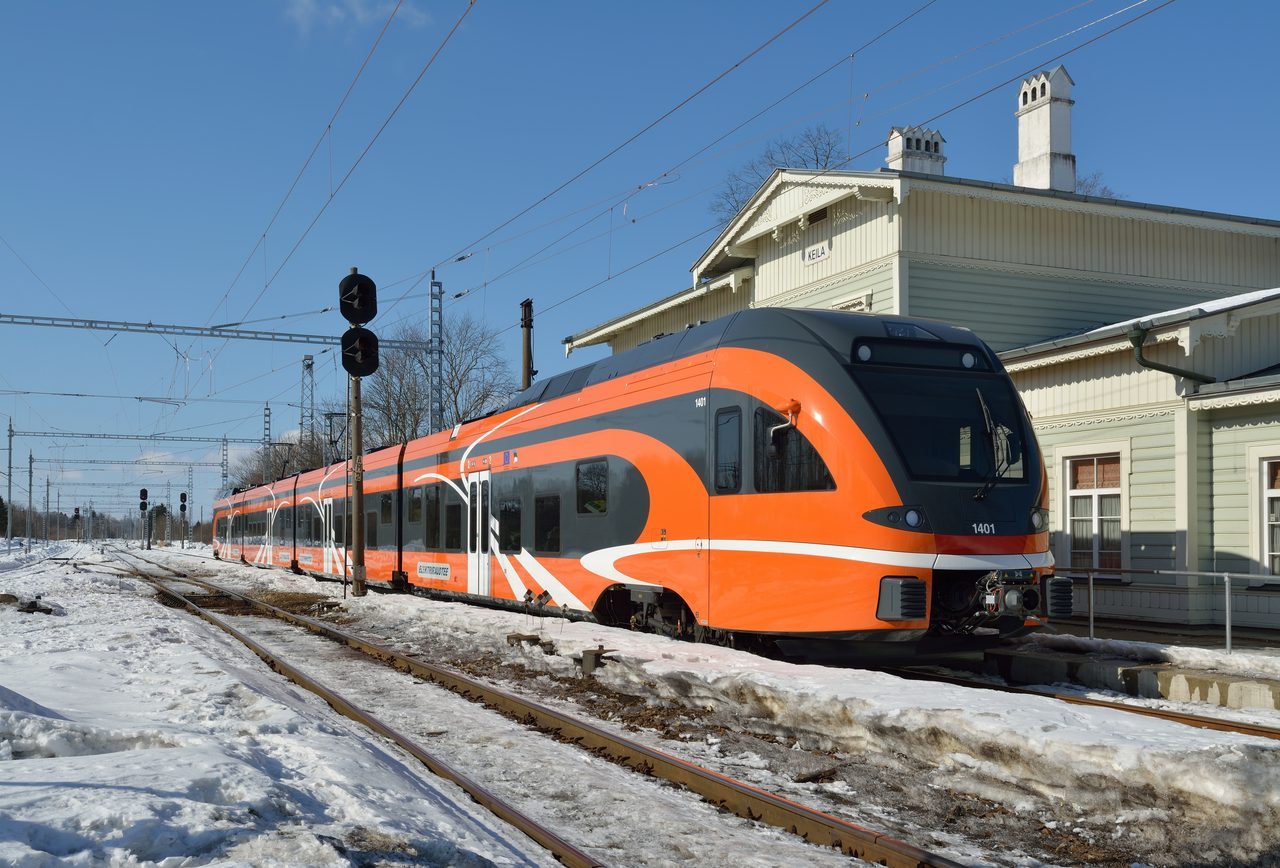
Photograph · “Stadler Flirt Keila jaamas1” by Ivar Leidus — CC BY-SA 3.0 · Credits
01 In brief
Stadler Rail has built trains since 1942, when engineer Ernst Stadler's small workshop took its first orders in a country whose railways were otherwise served by giants. Headquartered today at Bussnang in Thurgau, it has become one of Europe's largest rail manufacturers, with roughly 14,000 people across some fifty companies in more than twenty countries.
The rise came the slow way: narrow-gauge multiple units, rack-railway vehicles and shunting locomotives — work the industry giants found too small — until the FLIRT regional train turned Stadler into a fixture of European tendering. A flotation on the Swiss stock exchange in 2019 confirmed the transformation; today the company builds everything from trams to high-speed trainsets and sleeper cars.
02 Why it's interesting
- 01 It survived — and then thrived — by specialising in what others would not build: mountain rack railways, metre-gauge multiple units and tailor-made vehicles for small networks.
- 02 Stadler is one of the world's few remaining builders of rack-railway rolling stock, keeping alive the technology that climbs gradients ordinary adhesion railways cannot.
- 03 Its FLIRT family became one of Europe's most-ordered regional trains — a Swiss export story played out in tenders from the Baltic states to North America.
- 04 It remains anchored in Swiss ownership and Thurgau manufacturing — a family-firm culture that has outlasted nearly every independent competitor of its founding era.
03 How it works
Stadler's engineering culture prizes modularity and customisation: standardised drivelines, carbodies and bogies are combined into vehicles tailored to each railway's gauge, platform heights and timetable.
The FLIRT (Fast Light Intercity and Regional Train) family illustrates the method: a multiple unit with distributed traction whose modules — power sections, intermediate cars, train lengths — are arranged to match each operator's specification. The GTW articulated railcar and the KISS double-decker family extend the same logic to other market segments.
For mountain railways, Stadler maintains deep series experience in rack drive — the system in which a toothed wheel under the vehicle engages a cog rail laid between the running rails on steep gradients. The catalogue spans trams, metro cars, intercity and sleeper trainsets, plus the servicing that keeps small networks independent.
| Founded | 1942 (Ernst Stadler) |
|---|---|
| Headquarters | Bussnang, Thurgau |
| Employees | ~13,900 (2023) |
| Group footprint | ~50 companies · 23 countries |
| Flagship families | FLIRT · KISS · GTW |
| Listed | SIX Swiss Exchange, 2019 |
Figures per Stadler's published annual reporting and public company records.
04 The organisation behind it
Peter Spuhler, who acquired the then-small company in 1989 and over three decades turned it into a global manufacturer, remains its executive chairman; since the 2019 flotation the shares have traded on the Swiss exchange, with his holding company as the largest shareholder. The firm still builds in Bussnang what most competitors build wherever labour is cheapest — one reason it is regularly cited as a Swiss industrial exception.
05 In the real world
Stadler trainsets now run from the Baltic states to North America. For the Alpine region the company matters twice over: it keeps complete rolling-stock engineering in the mountains, and it supplies the mountain railways themselves — the cog lines and narrow-gauge railways on which Alpine public transport still depends.
06 Can you visit?
The Bussnang works receive booked groups — schools, associations, railway professionals — rather than walk-in tourists; contact the company in advance to ask about availability.
Riding the output is easier: FLIRTs and KISSes can be boarded on ordinary Swiss tickets, and many of the country's most scenic narrow-gauge lines run Stadler vehicles.