
SCIENCE & FRONTIER RESEARCH · SWITZERLAND
IBM Research – Zurich
Two Nobel Prizes, the first view of atoms, and the quantum frontier
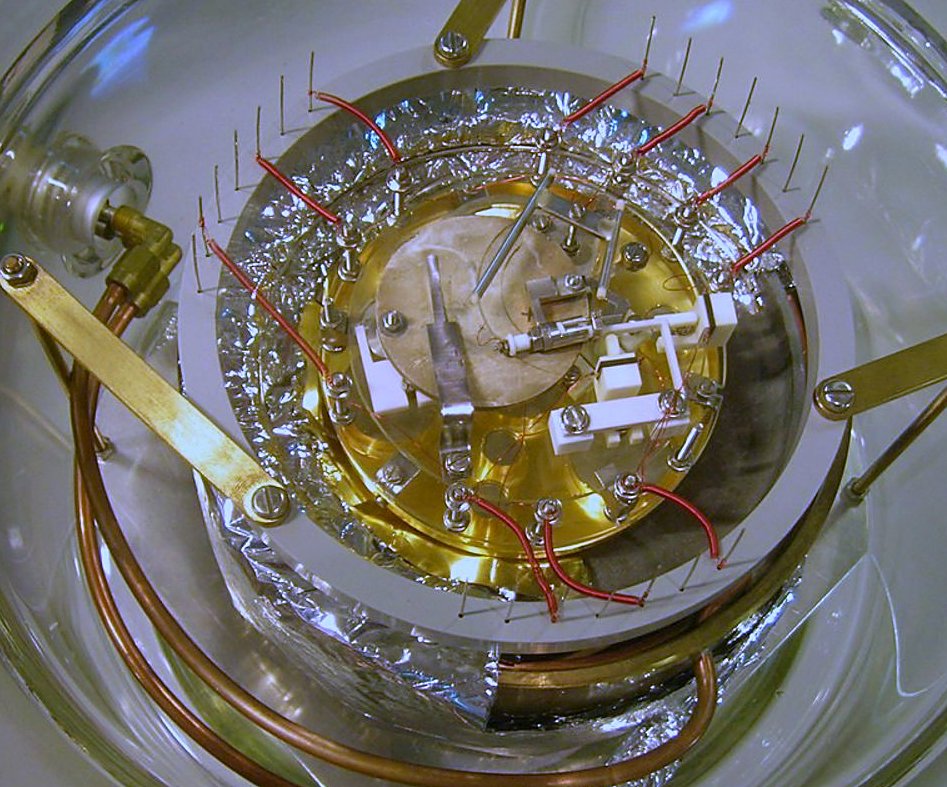
Photograph · The first scanning tunnelling microscope — built at the Zurich laboratory — “First Scanning Tunneling Microscope Deutsches Museum” by brewbooks — CC BY-SA 2.0 · Credits
01 In brief
IBM Research – Zurich, on the shore of Lake Zurich in Rüschlikon, opened in 1956 as IBM's first research laboratory outside the United States. Nearly seventy years later it remains one of Europe's most productive industrial laboratories, with research staff drawn from more than 45 countries.
Its history includes two Nobel Prizes in Physics. Heinrich Rohrer and Gerd Binnig shared the 1986 prize for the scanning tunnelling microscope, an instrument they built at the laboratory in 1981 that made individual atoms visible for the first time; Georg Bednorz and Alex Müller won the 1987 prize for the discovery of high-temperature superconductivity in ceramic materials a year earlier. Few corporate laboratories anywhere can point to a comparable decade.
02 Why it's interesting
- 01 It is the birthplace of the scanning tunnelling microscope — the instrument that opened the nanoworld, and the ancestor of the atomic-force microscopes now standard in research and production worldwide.
- 02 The discovery of high-temperature superconductivity in ceramics rewrote a chapter of condensed-matter physics and launched a materials race that continues in energy research today.
- 03 The laboratory works at computing's frontier — quantum technologies, artificial intelligence and quantum-safe security are current pillars — the kind of long-horizon research few companies still fund.
- 04 Its Binnig and Rohrer Nanotechnology Center, operated jointly with ETH Zurich, provides cleanrooms and noise-free labs that shield experiments down to the scale of single atoms.
03 How it works
IBM Research – Zurich works like a university embedded in a company: small teams, long time horizons, and instruments built in-house when the questions demand them.
The scanning tunnelling microscope works by scanning a conductive tip — ideally ending in a single atom — across a surface at a distance of less than a nanometre. A minute tunnelling current flows between tip and sample, and because that current varies exquisitely with distance, the instrument can map a surface atom by atom. Bednorz and Müller's superconductivity find, made while screening ceramic oxides, showed that materials long dismissed as insulators could carry current without resistance at temperatures far above what theory then comfortably explained.
Today's laboratory organises its work into three departments: algorithms, information, data and applications; quantum and AI technologies; and security research — including the post-quantum cryptography that prepares today's systems for tomorrow's quantum computers. The Binnig and Rohrer Nanotechnology Center, run with ETH Zurich, adds cleanroom and noise-free-lab infrastructure on the Rüschlikon campus, and the co-located Think Lab brings clients face to face with the research.
| Established | 1956 — first IBM lab outside the US |
|---|---|
| Nobel Prizes | 2 (Physics, 1986 and 1987) |
| Landmark instruments | Scanning tunnelling microscope (1981) |
| Research areas today | AI & algorithms · quantum · security |
| Staff nationalities | More than 45 |
| Location | Rüschlikon, Lake Zurich |
Figures per IBM Research's published laboratory profile and Nobel Prize records.
04 The organisation behind it
IBM Research – Zurich is the European hub of IBM's global research division, backed by one of the world's longest-established technology companies. That backing is what makes its time horizons possible: physics programmes that run for decades, and instruments built from scratch when commercial versions do not exist. The laboratory also serves as a training ground — generations of postdoctoral researchers and doctoral students pass through it, many carrying its precision culture into Swiss universities and industry.
05 In the real world
Technology that began in Rüschlikon is now everywhere. Scanning probe microscopes are standard tools in materials science, semiconductor development and quality control; the study of high-temperature superconductors continues in magnets, grids and computing research worldwide.
The laboratory's current security work on quantum-safe cryptography addresses a problem every organisation with long-lived data must eventually face — including banks and hospitals far from any physics laboratory.
06 Can you visit?
The laboratory is a working research site without regular public opening hours; organised groups and academic visitors are received by arrangement, but walk-in visits are not offered.
For a taste of the same research world in the Zurich area, ETH Zurich's campus and its public events — or the region's museums — are the practical alternative.