INDUSTRIAL MEMORY
Semmering Railway — the first mountain railway on Earth
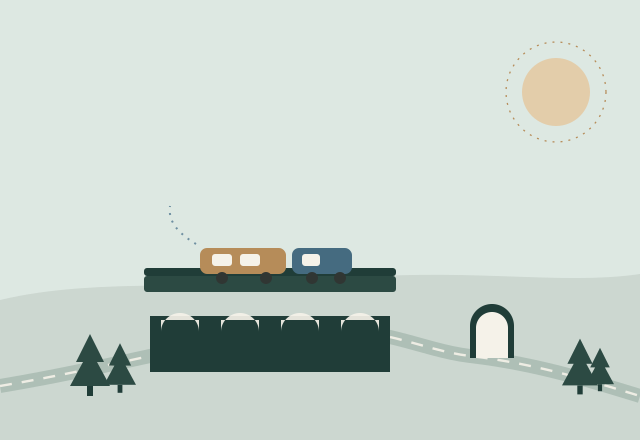
Built between 1848 and 1854 across the Austrian Alps between Gloggnitz and Mürzzuschlag, the Semmering Railway was the world's first true mountain railway — 41 kilometres, 14 tunnels and 16 viaducts, and a UNESCO World Heritage Site since 1998.
INTRODUCTION
What it is
When engineers of the Habsburg Empire set out to carry the railway over the Semmering pass in 1848, no precedent existed. Railways ran across plains and through gentle valleys; nobody had yet bent one around a mountain. Between Gloggnitz and Mürzzuschlag, over six years, they built 41 kilometres of line with 14 tunnels — including a 1,431-metre summit tunnel — and 16 major viaducts, and the world's first true mountain railway opened in 1854.
UNESCO inscribed the Semmering Railway on the World Heritage List in 1998 — the first railway line ever accepted — recognising both its engineering first and the cultural landscape it created: viaducts and station architecture set deliberately into the scenery.
WHY IT MATTERS
Why it is interesting
Every mountain railway since, including the Gotthard line profiled elsewhere in this Atlas, is a descendant of the problems solved at Semmering: how to gain altitude with adhesion alone, how to place structures on steep terrain, and how to survey a tunnel through a mountain without electronics.
The line is also living heritage in the strict sense — still carrying scheduled trains more than 170 years after opening, on its original structures, while the landscape around it became one of central Europe's classic resort regions precisely because the railway made it reachable.
HOW IT WORKS
Mechanism and method
The designers, led by Carl Ritter von Ghega, solved the altitude problem geometrically: the line climbs in sweeping arcs and horseshoe curves, at one point turning almost a full circle, to gain height at a gradient adhesion locomotives of the day could handle. The famous double-deck viaducts — Krausel Klause and Kalte Rinne among them — carry the line across the valleys created by those same curves.
Construction employed tens of thousands of workers and pushed 1840s technology to its limits: the tunnels were driven by hand, from both ends, with surveying instruments accurate enough that the bores met. A curiosity recorded by UNESCO: the fourteen tunnels together total 1,477 metres — the same length, coincidentally, as the sixteen viaducts combined.
PRINCIPLES
The science and engineering behind it
The engineering principle is civil engineering as terrain management: minimise gradient, accept curvature, and integrate the structures so that arches, piers and embankments behave as one system. The operational principle was adhesion-only railroading — special Engerth locomotives with articulated tenders were developed for the line's gradients.
The aesthetic principle is also deliberate: Ghega treated the railway as architecture within landscape, alternating tunnels and viaducts so the traveller experiences the mountain rather than avoiding it — a philosophy that made the line a destination in itself.
THE ORGANISATION
Who is behind it
Carl Ritter von Ghega (1802–1860), the Venetian-born engineer of Albanian descent who designed the line, learned from the gradients of American railroads before committing his own solution to the Alps. His Semmering work became the reference for alpine railway engineering across Europe.
Today the line belongs to the Austrian Federal Railways' network. ÖBB is separately constructing the Semmering Base Tunnel, a project that will carry long-distance traffic under the pass at a lower elevation while the historic surface line continues to serve regional traffic — the 2016 Gotthard and 1854 Semmering as two ends of one long engineering conversation.
APPLICATIONS
Where it is used
The line's original application was imperial connectivity — Vienna to the Adriatic — and the resort economy that grew along it invented alpine tourism. Its present application is regional transport and heritage: scheduled trains, museums and the walking trails that follow the viaducts.
VISITING
Can the public experience it?
The simplest visit is a train ride: regional services between Vienna and Mürzzuschlag cross the pass on the original structures. The stations at Semmering and the surrounding villages sit at the heart of a walkable landscape, with hiking routes that approach the great viaducts on foot.
Railway heritage collections at either end of the line document the construction era, and the UNESCO inscription's documentation provides a self-guided framework for reading the engineering in the scenery.