ADVANCED MAKING
NEST — the building that rebuilds itself for science
On the Empa campus in Dübendorf stands a building designed never to be finished: NEST, inaugurated in 2016, couples a permanent core with exchangeable research units where new construction technologies are tested under real living and working conditions.
INTRODUCTION
What it is
Construction is one of the world's most conservative industries: a new material or method can take decades to travel from laboratory to building site, because no one can test it at full scale without first committing a real building. NEST, a research building inaugurated on 23 May 2016 on the Empa and Eawag campus in Dübendorf near Zurich, was built to break exactly that bottleneck.
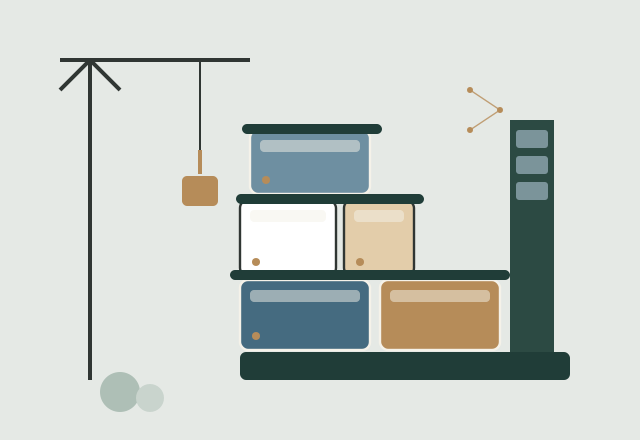
Its trick is architectural: a permanent backbone of platforms and supply cores, onto which research units — complete prefabricated storeys — can be docked, operated, evaluated, removed and replaced. The building is never finished; that is the point.
WHY IT MATTERS
Why it is interesting
NEST turns the construction site into a repeatable experiment. Each unit hosts a consortium of industry partners and researchers who test a technology in genuine conditions — real weather, real users, real maintenance schedules — for a few years, generating the performance data that standards bodies, insurers and investors need before a material or system can go mainstream.
The most famous result is DFAB HOUSE, a unit built by researchers of the Swiss National Centre of Competence in Research Digital Fabrication: a three-storey demonstrator whose structure was planned and produced digitally — robot-built timber modules, a robotically fabricated steel mesh, 3D-printed formwork for a smart-slab ceiling — among the first habitable buildings to combine these methods at full scale.
HOW IT WORKS
Mechanism and method
The platform idea is the mechanism. The core provides structure, utilities and lab infrastructure; the units plug in like modules of a rack server. When a unit's research programme ends, the unit is dismantled and the platform is released for the next consortium — so the building's research throughput is continuous even as its individual parts change.
Units so far have targeted digital fabrication, energy systems, adaptive façades, circular material flows and urban mining — the systematic recovery of materials from buildings at end of life. Data from sensors embedded throughout the building feeds the evaluation.
PRINCIPLES
The science and engineering behind it
The principle is in-situ validation at 1:1 scale — the construction industry's equivalent of the wind tunnel or crash test. Laboratory certificates cannot capture how a material behaves under real occupancy, and NEST exists precisely to make that gap measurable.
A second principle is circularity by design: because units are exchangeable, the building demonstrates construction as a reversible assembly rather than a one-way pour, aligning with Switzerland's growing focus on the built environment as a material bank.
THE ORGANISATION
Who is behind it
NEST is operated by Empa, the Swiss Federal Laboratories for Materials Science and Technology, founded in 1880 and today part of the ETH Domain, together with the water research institute Eawag. The building celebrated its tenth anniversary in 2026, by which time it had hosted a long succession of research and industry consortia.
DFAB HOUSE involved eight ETH Zurich professorships within the NCCR Digital Fabrication, showing the model's reach: universities supply methods, Empa supplies the full-scale testbed, industry supplies components and commercial reality.
APPLICATIONS
Where it is used
Technologies proven at NEST are designed to enter the construction industry: digital fabrication methods that reduce material use, energy units that manage buildings as power-grid participants, and façade systems that cut heating and cooling demand. The building functions as the de-risking step between paper and product.
VISITING
Can the public experience it?
NEST can be visited as part of guided tours of the Empa campus in Dübendorf, which are offered for groups by arrangement; Empa also holds public open days during which the research buildings are accessible. The campus is a short ride from Zurich by train and tram.
Because the units change over the years, a visit is worth repeating — the building on show is, by design, not the building that was inaugurated in 2016.